

HT and LT Electrical Installations — What Every Kerala Homeowner Should Know
Infrawatts · Electrical Engineering Guide · Kerala
Indroduction
Before a single wire is laid in your new home, one critical decision shapes everything that follows: the type of electrical supply connection your building will receive. Understanding the difference between High Tension (HT) and Low Tension (LT) installations is not just technical knowledge for engineers — it is essential information for every homeowner planning construction in Kerala.HT and LT Installations What Every Kerala Homeowner Should Know
What is the Difference Between HT and LT Electrical Installations?
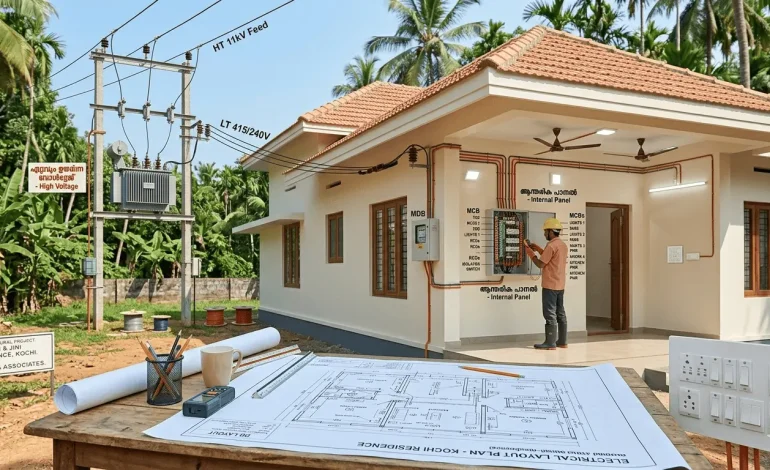
In the simplest terms, LT (Low Tension) supply is the standard electrical connection provided by KSEB to individual homes and small establishments. It operates at voltages up to 1,000 volts and is delivered directly from a nearby distribution transformer to your service connection point.
HT (High Tension) supply, on the other hand, is supplied at voltages above 1,000 volts — typically at 11 kV or 33 kV in Kerala — and is used when the connected electrical load of a building or complex exceeds the capacity of a standard LT connection. The consumer receives HT power and steps it down using their own transformer installed on the premises.
| HT — High Tension Above 1,000 V (typically 11 kV or 33 kV) For large villas with high loads, apartment complexes, commercial buildings, and gated communities. Consumer owns and maintains the transformer. KSEB meters at HT level. |
| LT — Low Tension Up to 1,000 V (230 V single-phase or 415 V three-phase) Standard connection for individual homes and small shops. KSEB supplies stepped-down power from its own distribution transformer. Simpler to apply for and maintain. |
When Does a Kerala Home or Residential Project Need an HT Connection Instead of LT?
Most individual homes in Kerala qualify for a standard LT three-phase connection, which can typically handle loads up to around 50 kW depending on the feeder capacity in your area. Beyond this threshold, or when KSEB’s existing LT infrastructure in your locality cannot support additional load, an HT connection becomes necessary.
Common residential scenarios that require HT supply include large gated community projects, apartment blocks with centralised air conditioning, lifts, common area lighting, pumping stations, and large independent homes with combined loads exceeding KSEB‘s LT supply limits.
Practical rule of thumb for Kerala: If your sanctioned connected load is expected to exceed 50 kW, or if you are developing a multi-unit residential complex, an early assessment by a qualified electrical consultant is essential to determine whether HT supply will be required and to begin the KSEB approval process accordingly.
What Are the Key Safety and Compliance Requirements for HT/LT Installation in Kerala?
All HT/LT installations in Kerala must comply with the Indian Electricity Rules, 2005, the Central Electricity Authority (CEA) regulations, and KSEB’s specific technical standards for service connections. Non-compliance results in connection refusal, show-cause notices, or disconnection.
For HT consumers, this includes proper transformer yard design with adequate clearances, oil containment pits, earthing systems, lightning protection, and metering cubicle specifications approved by KSEB. LT installations must meet IS 732 wiring standards, proper earthing as per IS 3043, and correct MCB/ELCB/RCCB ratings at the distribution board.
- Licensed Electrical Contractor (LEC) and Electrical Supervisor registration with KSEB for all HT work
- Single-line diagram (SLD) approved by KSEB before installation commences
- Correct earthing system — TN-S or TT configuration as applicable
- Protection relay settings reviewed and approved for HT installations
- ELCB and RCCB at all final circuits in LT residential wiring
- Mandatory test certificates before energisation — insulation resistance, earth continuity, loop impedance
What Does the HT/LT Installation Process Look Like From Design to Energisation in Kerala?
The journey from sanctioned load to a live electrical connection involves several coordinated stages. Delays at any one stage — often caused by incomplete documentation or non-compliant design — can push back your entire construction timeline by weeks or even months.
1)Load assessment
Calculate total connected and maximum demand load. Determine HT or LT category.
2)KSEB application
Submit service connection application with load details, ownership documents, and building permit.
3)SLD approval
Electrical designers prepare the single-line diagram. KSEB reviews and approves layout and equipment specs.
4)Civil works
Transformer yard, cable trench, panel room, and earthing pit constructed in coordination with civil team.
4)Installation & testing
Equipment installed, tested, and all compliance certificates prepared for KSEB inspection.
5)Energisation
KSEB inspection, approval, and live connection. Metering commissioned and supply released.
Why Should HT/LT Planning Be Done Alongside Civil and Structural Design?
One of the most common and costly mistakes in Kerala home construction is treating electrical planning as a separate, later-stage activity. In reality, civil and electrical engineering are deeply interdependent — especially when HT supply is involved.
The transformer yard location must be decided before the site layout is finalised. Cable trench routing affects foundation and plinth beam positions. Panel room dimensions need to be accounted for in the architectural plan. Earthing pit placement must avoid conflicts with underground drainage and structural footings.
When electrical designers work in close coordination with the civil and structural team from the design stage, all of these elements are resolved on paper — not through expensive corrections on site. This integrated approach is central to how Infrawatts delivers its electrical engineering consulting services in Kochi and across Kerala.
What Are the Common Mistakes Kerala Homeowners Make With HT/LT Installations?
Common pitfalls to avoid
Underestimating connected load at the application stage, leading to a need for costly load enhancement later. Selecting unqualified contractors unfamiliar with KSEB’s HT technical standards. Skipping detailed earthing design, which causes persistent tripping and equipment damage. Not allocating adequate physical space for the transformer yard within the site plan. Delaying KSEB application until construction is nearly complete, pushing occupancy timelines significantly.
Each of these mistakes is preventable with the right electrical engineering consulting support from the outset. A qualified team of electrical designers familiar with KSEB procedures can anticipate these issues and design around them before they become site problems.
How Do I Choose the Right Electrical Engineering Consulting Service in Kochi for My HT/LT Project?
Look for a firm that employs licensed electrical engineers with direct HT installation experience in Kerala, not just general contractors. They should be capable of delivering complete project documentation — load calculations, SLD, protection coordination study, earthing design, and as-built drawings — and have an established working relationship with KSEB approval processes.
Equally important is their ability to coordinate with your civil contractor and architect. An electrical consultant who works in isolation from the rest of your project team creates handover gaps that lead to costly rework. The best outcomes come from integrated civil and electrical engineering teams who share drawings, attend site meetings together, and resolve clashes before construction begins.
Infrawatts offers exactly this — a fully integrated electrical engineering consulting service in Kochi with demonstrated HT/LT installation expertise, KSEB liaison support, and coordinated project delivery across residential and commercial projects throughout Kerala.
Conclusion
Understanding the distinction between HT and LT installations is the first step every Kerala homeowner and developer should take before breaking ground. Whether your project needs a straightforward LT three-phase connection or a full HT supply with a dedicated transformer yard, the decisions made at the planning stage determine the safety, compliance, and performance of your electrical infrastructure for decades to come.
Don’t leave your HT/LT installation to guesswork or unqualified contractors. Engage experienced electrical designers and a trusted consulting team who know Kerala’s regulatory landscape and KSEB requirements inside out.
Copyright 2021 All Rights Reserved Infrawatts